QUARDIAN SSO
One authentication grants access to every service — dual quantum key verification delivers the convenience of SSO without giving up security.
Managing a separate account for every service is a burden, and a single leaked account spreads across many services — single sign-on has to solve both at once.
Convenience and security in single sign-on are no longer separate paths.
The more convenient one login becomes, the greater the risk hidden behind it.
Structural risk: single point of failure
Because SSO grants access to many services with one authentication, breaching that single credential exposes every connected service at once.
Reuse of a static session
Most single sign-on systems keep trusting the same session or token after the initial authentication. Without re-verification, a hijacked session is indistinguishable from a legitimate one.
Keep the single login, and add one more layer of quantum key verification behind it.
Rather than relying on one credential, we confirm it once more with a quantum key.
The user requests initial authentication with their unified account credentials
A patented quantum-entropy-based algorithm verifies the identity a second time
Once verified, every connected service is accessible without logging in again
Rather than depending on one credential, a breach is stopped at the next gate.
Conventional
Trying a leaked password across many services succeeds once, exposing every connected service at once
Quardian
Even a breached password is re-checked at the dual quantum key verification step — access is denied without it
Conventional
A stolen session token alone grants continued access with no re-authentication, making it hard to detect
Quardian
Quantum key verification re-confirms identity at every authentication, so a hijacked session alone cannot pass
Conventional
Unified login credentials entered on a phishing site are stolen outright, exposing every connected service
Quardian
Stolen credentials alone cannot pass dual quantum key verification, so access is blocked
Single credential
A single credential is a single point of failure
SSO with dual quantum key verification
Patent registered 2025.04
SSO plus a separate OTP step
The more security is added, the worse the experience gets
The login flow users see stays the same — quantum key verification happens once more behind the scenes
Single Sign-On
Single sign-on request
Login
The user requests initial authentication with unified account credentials
Track login events across every connected service in real time and automatically block anomalous attempts.
The figures above are illustrative example data showing the screen's structure.
Connects to existing systems with no code changes via SAML/OIDC, and syncs users automatically via SCIM.
SSO service authentication system with dual quantum key verification — formally registered with the Korean Intellectual Property Office in April 2025.
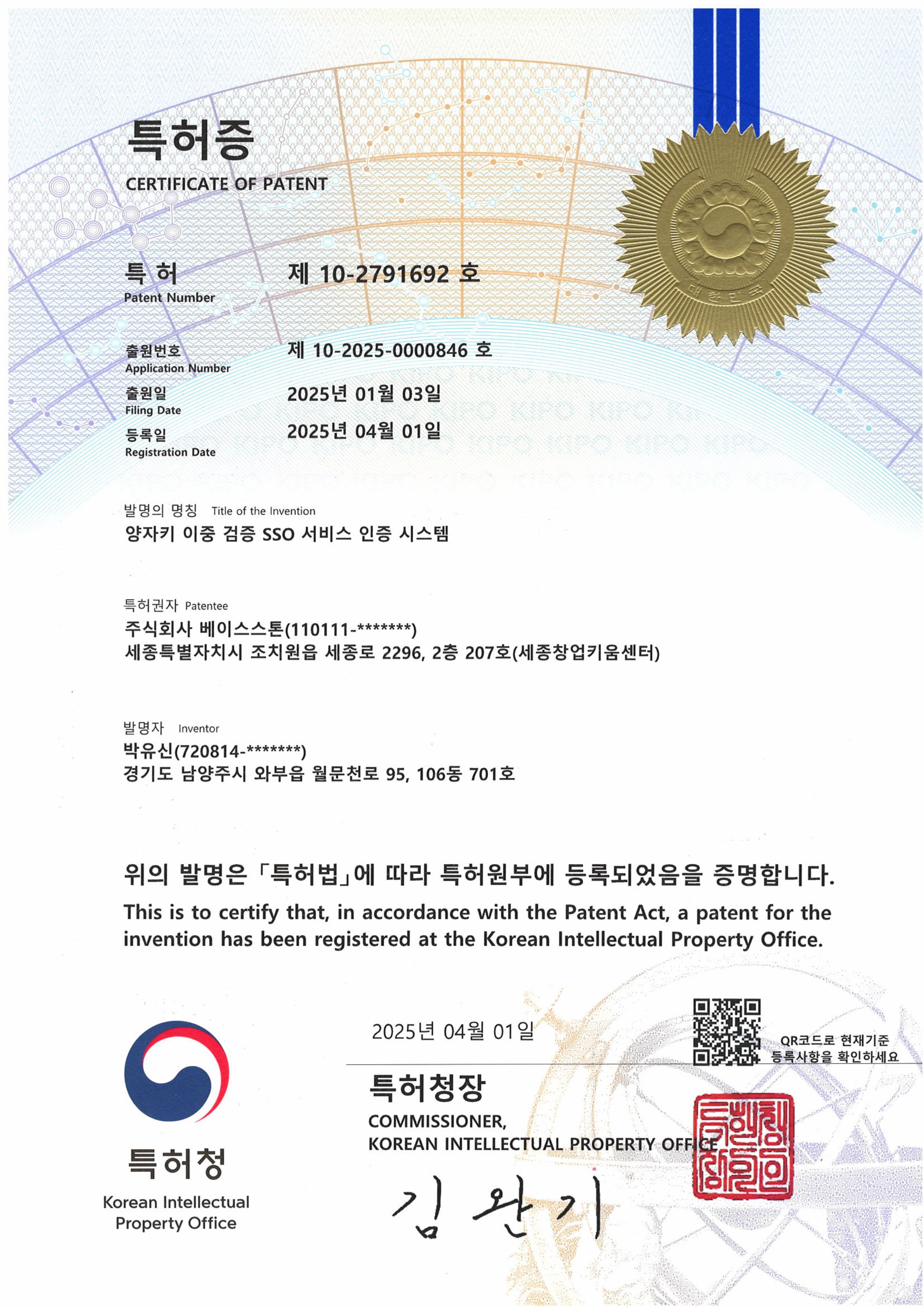
Patent No. 10-2791692, Registered 2025.04.01, Korean Intellectual Property Office
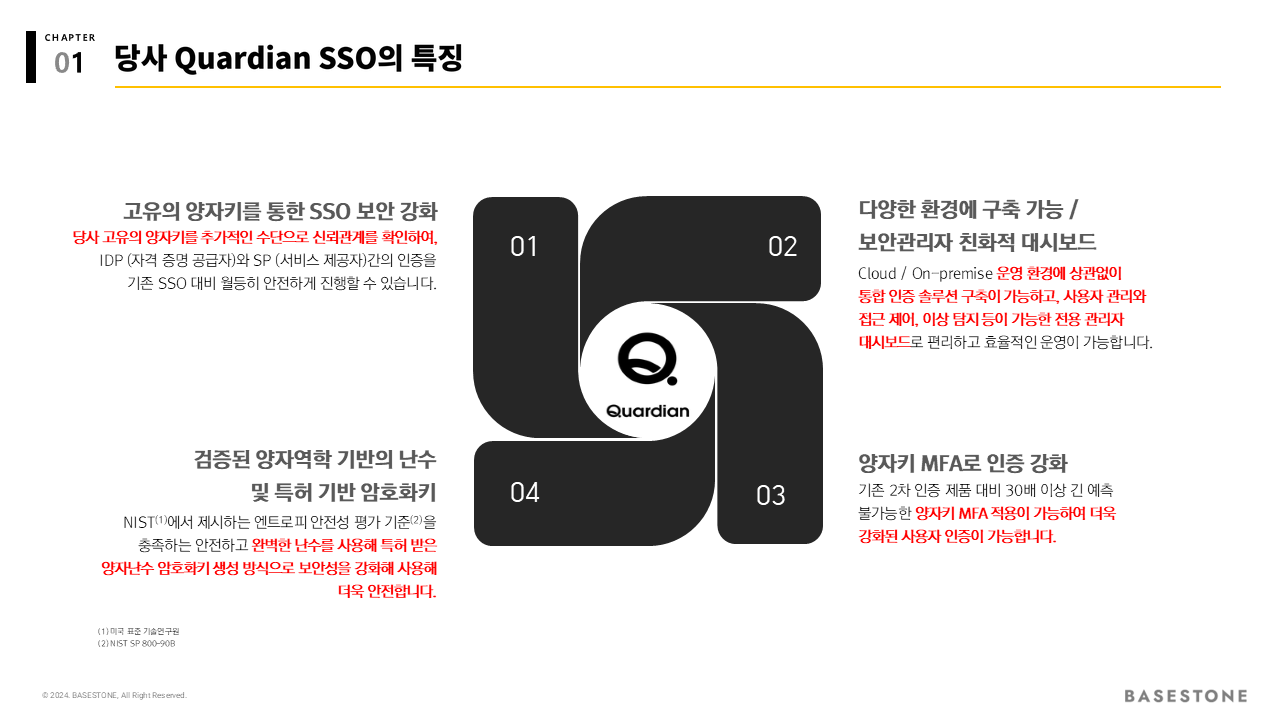
Common questions when evaluating Quardian SSO.
After a first-factor login with the unified credential, a patented (Patent No. 10-2791692) quantum-key-based algorithm re-verifies identity as a second factor — a dual-verification structure.
No. After the first authentication, users reach every connected service without logging in again — the experience stays the same while the extra verification happens automatically behind the scenes.
Yes, it supports the SAML/OIDC standards for integration without code changes, and SCIM automatically syncs user accounts.
Even if credentials are stolen, access is denied unless the quantum-key dual verification also passes, so a single credential leak doesn't automatically expose every connected service.
Yes. It was officially registered with the Korean Intellectual Property Office in April 2025 as Patent No. 10-2791692.
Need more detail or considering a deployment? Reach out any time.